
Shopify vs WooCommerce: Which is Better for Your Mumbai Business in 2026?
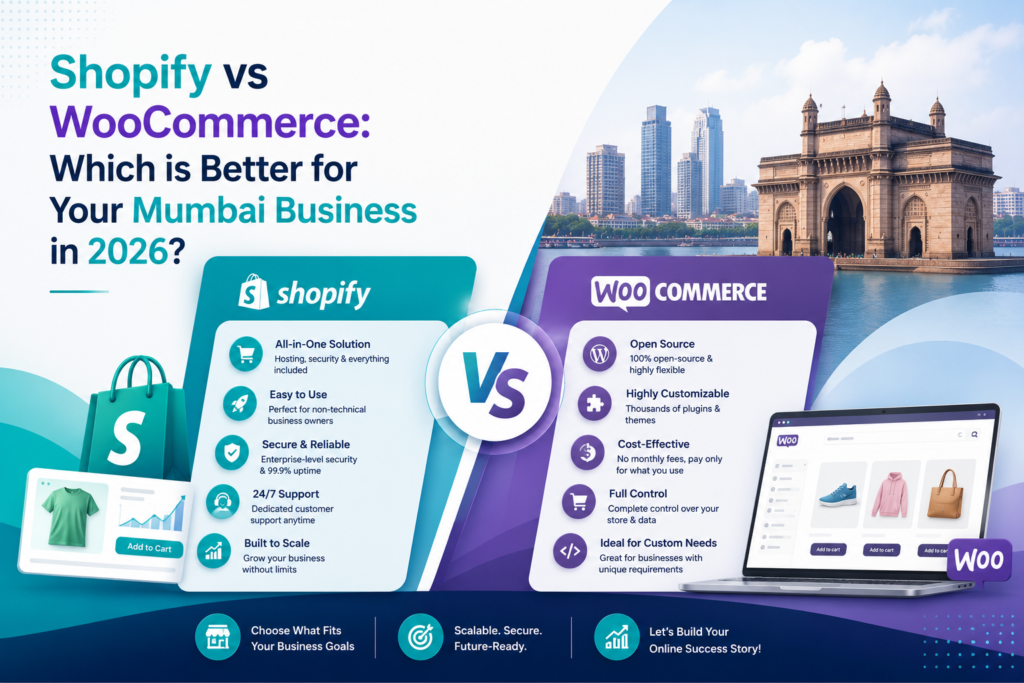
Choosing the right eCommerce platform is one of the most important decisions for any business planning to sell online. Two of the most popular platforms available today are Shopify and WooCommerce. Both offer powerful features, flexibility, and scalability — but the best choice depends on your business goals, budget, and technical requirements.
For businesses in Mumbai looking to launch or expand an online store, understanding the differences between Shopify and WooCommerce can help make an informed decision that supports long-term growth.
In this guide, we compare Shopify and WooCommerce across key factors including ease of use, pricing, customization, SEO, security, and scalability.
Understanding Shopify
Shopify is a fully hosted eCommerce platform designed specifically for online selling. It provides everything needed to run an online store — including hosting, security, payment processing, and store management tools — without requiring advanced technical knowledge.
Key Features of Shopify
- Fully Hosted Platform — No separate hosting required.
- User-Friendly Dashboard — Simple interface for non-technical users.
- Secure Hosting Included — SSL and PCI compliance built in.
- Mobile-Responsive Themes — All themes are optimized for mobile devices.
- Built-In Payment Gateway — Accept payments without third-party setup.
- App Marketplace — Thousands of apps to extend functionality.
- Inventory Management — Track and manage products with ease.
- Marketing Tools — Built-in email, SEO, and discount tools.
Shopify is particularly popular among startups, retailers, and businesses that want a simple and reliable eCommerce solution.
Understanding WooCommerce
WooCommerce is an open-source eCommerce plugin built for WordPress. It transforms a WordPress website into a fully functional online store. Unlike Shopify, WooCommerce requires separate hosting, security management, and website maintenance — but it offers extensive flexibility and customization in return.
Key Features of WooCommerce
- Open-Source Platform — Free to use with full code access.
- Full Website Control — Own your data and infrastructure completely.
- Unlimited Customization — Modify every aspect of your store.
- Thousands of Plugins — Extend functionality for any business need.
- SEO-Friendly Structure — Built on WordPress, the most SEO-capable CMS.
- Flexible Product Management — Supports simple, variable, grouped, and digital products.
- Multiple Payment Options — Integrate any payment gateway globally.
- Scalable Functionality — Grows with your business when properly hosted.
WooCommerce is often preferred by businesses that require greater customization and full control over their website.
Shopify vs WooCommerce: Ease of Use
Shopify
Shopify is designed for beginners and non-technical users. Key advantages include:
- Simple setup process — launch in days, not weeks
- User-friendly dashboard with no learning curve
- No coding required for day-to-day management
- Automatic updates handled by Shopify
- Managed hosting with no server configuration
WooCommerce
WooCommerce offers greater flexibility but requires more technical involvement. Business owners may need assistance with:
- Hosting setup and server configuration
- Theme installation and configuration
- Plugin management and compatibility
- Security updates and backups
- Performance optimization
Winner: Shopify — For ease of use and faster setup, Shopify is generally the better option for non-technical business owners.
Shopify vs WooCommerce: Customization
Shopify
Shopify offers customization through themes and apps. While options are extensive, there are some limitations compared to open-source platforms. Deep customization requires knowledge of Shopify's Liquid templating language.
WooCommerce
WooCommerce provides virtually unlimited customization. Businesses can:
- Modify design completely with any WordPress theme
- Add custom functionality with plugins or custom code
- Create unique user experiences tailored to their audience
- Integrate advanced business systems like ERP or CRM
Winner: WooCommerce — For businesses requiring complete customization and design freedom, WooCommerce offers far greater flexibility.
Shopify vs WooCommerce: SEO Performance
Search engine optimization is critical for driving organic traffic and increasing online visibility. Both platforms support SEO, but WooCommerce has a natural advantage through WordPress.
Shopify SEO Features
- Custom meta titles and meta descriptions
- Mobile optimization out of the box
- SSL security included on all plans
- Automatic XML sitemaps
- Fast managed hosting
WooCommerce SEO Features
- Complete SEO control via plugins like Yoast or Rank Math
- Advanced URL structure customization
- Powerful on-page and technical SEO capabilities
- Deep content marketing and blogging integration
- Schema markup and structured data support
Winner: WooCommerce — For businesses focused heavily on SEO and content marketing, WooCommerce offers more advanced optimization options through WordPress.
Shopify vs WooCommerce: Pricing
Shopify Costs
Shopify follows a subscription-based pricing model. Costs generally include:
- Monthly subscription fee (plans vary by tier)
- Premium theme purchases (one-time cost)
- App subscriptions for additional features
- Transaction fees if not using Shopify Payments
The predictable pricing model makes budgeting straightforward for growing businesses.
WooCommerce Costs
WooCommerce itself is free, but additional expenses may include:
- Web hosting (monthly or annual)
- Domain name registration
- Premium themes and page builders
- Plugin licenses for added functionality
- Developer support for setup and maintenance
Winner: Depends on Business Needs — Small businesses often appreciate Shopify's simplicity and fixed pricing. Larger custom projects may benefit more from WooCommerce's flexibility despite variable costs.
Shopify vs WooCommerce: Security
Shopify
Security is managed entirely by Shopify. Benefits include:
- SSL certificates included on all plans
- PCI DSS compliance for secure payment processing
- Automatic platform updates
- Fully managed hosting environment
- Regular security monitoring by Shopify's team
WooCommerce
WooCommerce security depends on your hosting provider and maintenance practices. Businesses must manage:
- WordPress and plugin updates
- Regular backups
- Security plugin configuration
- Malware scanning and protection
Winner: Shopify — For businesses seeking hassle-free, fully managed security, Shopify is the stronger choice.
Shopify vs WooCommerce: Scalability
As businesses grow, the ability to scale becomes increasingly important.
Shopify
- Supports large product catalogs without performance issues
- Handles high traffic volumes on all plans
- Enables international selling and multi-currency support
- Supports multi-channel commerce across social and marketplaces
WooCommerce
- Scales effectively with quality managed hosting
- Supports enterprise-level stores with proper infrastructure
- Handles complex product catalogs with custom taxonomies
- Flexible enough to accommodate unique business models
Winner: Tie — Both platforms can support growing businesses when properly configured and hosted.
Which Platform is Best for Mumbai Businesses?
Choose Shopify If:
- You want to launch your online store quickly
- You prefer minimal technical management day-to-day
- You need reliable hosting and security without extra effort
- You want a user-friendly platform your team can manage independently
Choose WooCommerce If:
- You require advanced customization unique to your business
- SEO and content marketing are a major priority
- You already have a WordPress website
- You want complete ownership and control over your store
Why Professional Development Matters
Regardless of the platform you choose, professional development can significantly impact your store's performance and success. Experienced developers can help with:
- Store Setup — Correct configuration from day one.
- Custom Design — A unique storefront that reflects your brand.
- SEO Optimization — Technical and on-page SEO best practices.
- Performance Improvements — Faster load times and better Core Web Vitals.
- Security Enhancements — Hardening your store against threats.
- Third-Party Integrations — CRM, ERP, payment gateways, and logistics.
A professionally developed store improves user experience, search visibility, and conversion rates — directly impacting your revenue.
Conclusion
Both Shopify and WooCommerce are excellent eCommerce platforms, but the right choice depends on your business objectives. Shopify is ideal for businesses seeking simplicity, speed, and ease of management. WooCommerce is better suited for businesses that require extensive customization, advanced SEO capabilities, and full control over their online store.
For businesses in Mumbai, evaluating your growth plans, technical requirements, and budget will help determine which platform is the best fit for your eCommerce journey.
Need help deciding? Our team offers professional Shopify development services in Mumbai and WooCommerce development services in Mumbai to help you launch the right way.
Related Services
- Shopify Development Services Mumbai
- WooCommerce Development Services Mumbai
- Ecommerce Development Services Mumbai
- Custom Website Development Services Mumbai
- Business Website Development Services Mumbai
Frequently Asked Questions
Is Shopify better than WooCommerce?
Shopify is better for ease of use and maintenance, while WooCommerce offers greater flexibility and customization. The best choice depends on your specific business requirements.
Which platform is more SEO-friendly?
WooCommerce generally provides more advanced SEO customization through WordPress and dedicated SEO plugins like Yoast and Rank Math.
Is Shopify suitable for small businesses?
Yes. Shopify is ideal for startups and small businesses due to its simplicity, managed hosting, and all-in-one infrastructure.
Can WooCommerce handle large online stores?
Yes. WooCommerce can support large stores effectively when paired with optimized managed hosting and proper development practices.
Which platform is more affordable?
The answer depends on your requirements. Shopify has predictable monthly pricing, while WooCommerce costs vary based on hosting, themes, plugins, and customization needs.
Can I migrate from WooCommerce to Shopify?
Yes. Professional developers can migrate products, customer data, orders, and content from WooCommerce to Shopify with minimal disruption to your business.